Exams / CSCO-200-301 / D1 Network Fundamentals
D1.1
Network Fundamentals (part 1 of 9)
- Exam domain: Network Fundamentals
You are reading a free preview. The rest of the CSCO-200-301 course unlocks with an Exam pass or All access.See plans
Layer 2 switching: learning, forwarding, flooding
| Step | What the switch does |
|---|---|
| Learn | Reads the source MAC of each incoming frame and maps it to the ingress port in the MAC (CAM) table. The table starts empty and fills dynamically. |
| Forward | Looks up the destination MAC (per VLAN) and sends the frame out the matching port. |
| Flood | Destination unknown: the frame goes out all forwarding ports in the VLAN except the one it came in on. |
- "LAN switches use forwarding tables ... to direct traffic to specific ports based on the VLAN number and the destination MAC address of the frame."
- A Layer 2 switch moves frames within a VLAN using MAC addresses. Moving traffic between VLANs or choosing WAN routes needs Layer 3.
- A switch does not send ARP, rewrite the destination to FFFF.FFFF.FFFF, or notify the sender when the destination is unknown.
- Aging: dynamic entries are deleted when no traffic is seen for the aging time.
VLANs and trunking
| Item | Fact |
|---|---|
| Normal range | 1-1005 (stored in the VLAN database) |
| Default VLAN | VLAN 1; VLANs 1 and 1002-1005 are created automatically and cannot be removed |
| Extended range | 1006-4094 (4096 is not valid) |
| Trunk tagging | IEEE 802.1Q inserts a 4-byte tag and recomputes the FCS |
"VLAN tagging" is the function that lets frames from several VLANs share one port while staying separated.
Spanning Tree: root bridge election
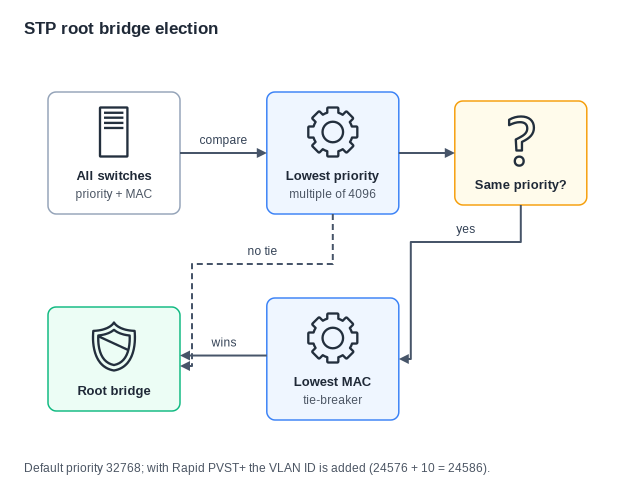
- Bridge ID = priority (most significant bits) + MAC address. Lowest wins.
- Default priority 32768. With the extended system ID, priority is a multiple of 4096 plus the VLAN ID (so a BID of 24586 = 24576 + VLAN 10).
- Exam recipe: (1) lowest priority number; (2) if tied, lowest MAC address, compared byte by byte from the left.
- If only MACs are shown (no priorities), assume all are default and pick the lowest MAC.
EtherChannel
| Protocol | Modes | Notes |
|---|---|---|
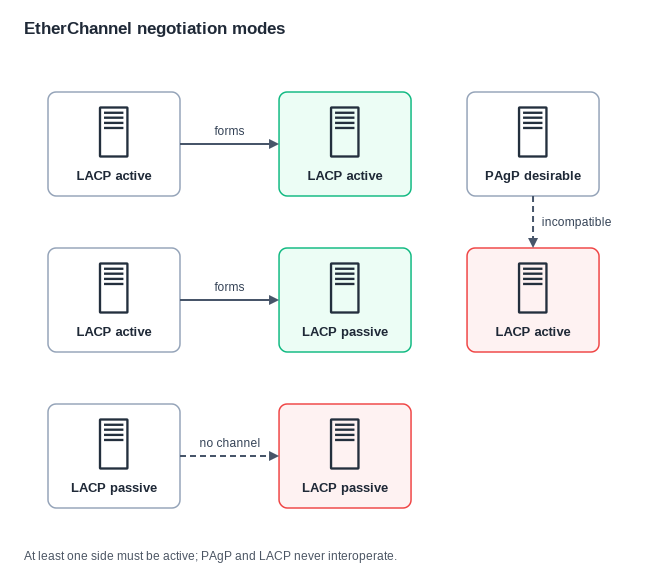
| LACP (IEEE 802.3ad) | active, passive | Channel forms if at least one side is active |
| PAgP (Cisco) | auto, desirable | Not compatible with LACP |
| Static | on | No negotiation protocol |
Layer 2 LACP bundle: same switchport mode on all members, channel-group N mode active.
Discovery protocols (CDP / LLDP)
| Item | CDP | LLDP |
|---|---|---|
| Carries | Native VLAN, duplex, VTP domain, platform | Standard TLVs |
| Not carried | Trunking protocol, STP protocol/priority |
| LLDP command | Purpose |
|---|---|
lldp timer |
Interval between advertisements (default 30 s) |
lldp holdtime |
How long the neighbor keeps the info (default 120 s) |
lldp reinit |
Delay before LLDP initializes on an interface (default 2 s) |
lldp tlv-select |
Which TLVs are sent |
Ethernet, collisions, cabling, SFP
- Half-duplex CSMA/CD: a frame is retried up to 16 times; after 16 failures it is dropped and counted as an excessive collision.
- Preamble alerts/synchronizes the receiver before the frame; the SFD marks the start of the actual frame.
- Copper 1000BASE-T: up to 100 m. Fiber: much longer reach and higher speeds.
- Multimode: several light paths, modal dispersion, short runs (data center). Single-mode: one path, long reach, little distortion.
- SFP/SFP+ modules (fiber or copper) are hot-swappable.
Campus design and wireless
- Three-tier: access / distribution / core. Collapsed core (two-tier): distribution doubles as core, cheaper, suited to small/medium campuses.
- SSID = the WLAN name; one SSID can be advertised by several APs.
- 2.4 GHz non-overlapping channels: 1, 6, 11.
- Cisco RRM/DCA assigns channels dynamically from interference, noise and load.
- LWAPP (predecessor of CAPWAP): Layer 2 mode uses an Ethernet encapsulation (EtherType), Layer 3 mode uses UDP and is the recommended one.
Controller-based vs traditional, cloud, virtualization, endpoints
| Cloud term | Meaning |
|---|---|
| Multitenancy | Several clients on shared infrastructure |
| Scalability / rapid elasticity | Capacity added and removed (automatically) with demand |
| On-demand | Resources allocated only when needed |
| Workload movement | Tasks migrated to other locations for cost/efficiency |
| Resiliency | Work recovers on healthy resources after a failure |
- VMs on one hypervisor share the host's physical hardware resources (CPU, memory, devices).
- Private (RFC 1918) addresses are non-routable on the Internet: they keep internal addressing out of the global routing table and let you build your own subnet hierarchy.
- TCP (connection-oriented): SMTP, SSH, FTP. UDP (connectionless): SNMP, TFTP, VoIP media.
Exam traps
- Root bridge: the lowest priority wins, even though it is called the "highest priority".
desirableis PAgP, not LACP; passive/passive never forms a channel.- Unknown unicast is flooded, not dropped or ARPed.
- CAM lookup uses the destination MAC; learning uses the source MAC.
lldp timer= send interval,holdtime= TTL,reinit= init delay,tlv-select= TLV content.- VLAN 1006 is extended range; 4096 is not a VLAN ID.
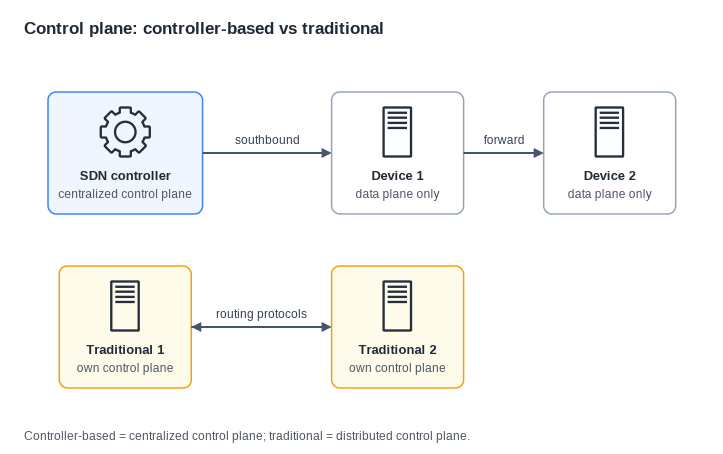
- Controller-based = centralized control plane; traditional = distributed control plane.
Docs
- https://www.cisco.com/c/en/us/td/docs/switches/lan/catalyst9300/software/release/16-10/configuration_guide/lyr2/b_1610_lyr2_9300_cg/configuring_spanning___tree_protocol.html
- https://www.cisco.com/c/en/us/td/docs/switches/lan/catalyst9300/software/release/16-12/configuration_guide/lyr2/b_1612_lyr2_9300_cg/configuring_etherchannels.html
- https://www.cisco.com/c/en/us/support/docs/interfaces-modules/port-adapters/12768-eth-collisions.html
- https://www.cisco.com/c/en/us/support/docs/switches/catalyst-6000-series-switches/23563-143.html
- https://www.cisco.com/c/en/us/td/docs/switches/lan/catalyst9200/software/release/17-12/configuration_guide/vlan/b_1712_vlan_9200_cg/configuring_vlans.html
- https://www.cisco.com/c/en/us/td/docs/ios-xml/ios/cdp/configuration/15-mt/cdp-15-mt-book/nm-cdp-discover.html
- https://www.cisco.com/c/en/us/td/docs/routers/ncs4000/software/reference/guide/otncommandreferenceguide/m-lldp.html
- https://www.cisco.com/c/en/us/td/docs/wireless/controller/9800/technical-reference/wireless-rf-reference-guide.html
- https://www.cisco.com/en/US/docs/solutions/Enterprise/Mobility/emob30dg/TechArch.html
- https://www.cisco.com/c/en/us/solutions/software-defined-networking/overview.html
- https://learn.microsoft.com/en-us/azure/architecture/guide/design-principles/scale-out