Exams / CSCO-200-201 / D1 Network Intrusion Analysis
D1.1
Network Intrusion Analysis (part 1 of 4)
- Exam domain: Network Intrusion Analysis
You are reading a free preview. The rest of the CSCO-200-201 course unlocks with an Exam pass or All access.See plans
Reading scans and floods in a capture
| Pattern in the capture | Meaning |
|---|---|
| One SYN per port across many ports | Port scan (half-open/SYN scan): reconnaissance |
| High-rate SYNs to one port, uniform timing, identical length/window | SYN flood (DoS) |
| Many sources, same destination | Distributed flood |
| One source, one destination, many SYN / SYN-ACK | Single-source SYN flood |
| Initial segment | SYN set, ACK clear (flags 0x002) |
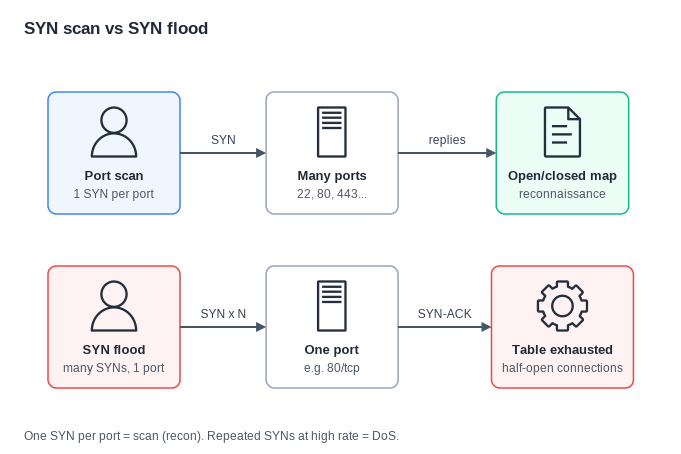
Nmap's SYN scan "is often referred to as half-open scanning". Port states: open, closed, filtered. Open ports expose services and versions (for example OpenSSH, Apache); a scan does not reveal local UIDs, uptime or connection capacity.
Know well-known ports: 21 FTP, 22 SSH, 25 SMTP, 53 DNS, 80 HTTP, 110 POP3, 443 HTTPS/TLS, 445 SMB.
TCP flags
| Flag | Role |
|---|---|
| SYN | Opens a connection |
| ACK | Acknowledges received data |
| FIN | Orderly close |
| RST | Aborts the connection immediately |
DNS attacks
| Attack | Clue |
|---|---|
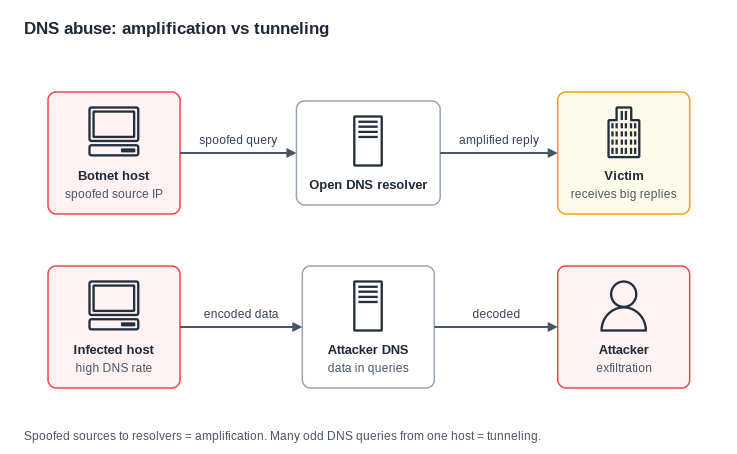
| DNS amplification/reflection | Spoofed source IPs of the victim, requests to resolvers |
| DNS tunneling | High frequency of DNS requests used for exfiltration |
| DNS flood | Large volume of DNS queries (UDP/53) to a server |
Visibility and evasion
| Topic | Key fact |
|---|---|
| NAT/PAT | Hides internal addresses; logs on each side of NAT show different IPs, so correlate with translation tables |
| TLS | Capture shows only Application Data; payload hidden |
| Fragmentation | Splits traffic to evade; defeated by reassembly (Wireshark TCP "Allow subdissector to reassemble TCP streams") |
| Tunneling / encryption / proxies | Other evasion families |
| Resource exhaustion | Denial of service |
| Stateful inspection vs DPI | Layer 4 state vs Layer 7 content |
| Inline vs mirroring | Inline acts on the original flow; mirroring copies traffic to a tool |
| Top talkers | Group by most active source IP to find a scanner |
| ARP cache poisoning | Several IPs share one MAC in the ARP table; enables man-in-the-middle on a switched LAN |
| C2 | Malware contacts a remote server for commands and updates |
| Reconnaissance | First kill-chain step: gathering target information |
Exam traps
- One SYN per port is a scan, not a flood.
- TCP is not an application protocol; ALPN strings (h2, http/1.1) inside a ClientHello do not make the traffic HTTP: the protocol is TLS (16 03 01).
- NAT does not encrypt and is not load balancing.
- DNS amplification uses spoofed sources; tunneling uses high volume of queries to exfiltrate.
- Several items are ambiguous in the bank (UDP/53 single packet, social engineering vs phishing, evidence types, ICMP "Unknown"): answer with the broadest expected category.
Docs
- https://nmap.org/book/man-port-scanning-techniques.html
- https://nmap.org/book/man-port-scanning-basics.html
- https://www.cisa.gov/news-events/alerts/2014/01/17/udp-based-amplification-attacks
- https://attack.mitre.org/techniques/T1499/
- https://attack.mitre.org/techniques/T1557/002/
- https://www.wireshark.org/docs/wsug_html_chunked/ChAdvReassemblySection.html
- https://www.cisco.com/c/en/us/td/docs/ios-xml/ios/netflow/configuration/15-mt/nf-15-mt-book/cfg-nflow-top-talk.html