Exams / ANS-C01 / D1 Network Design
D1.1
Network Design (part 1 of 5)
- Exam domain: Network Design
You are reading a free preview. The rest of the ANS-C01 course unlocks with an Exam pass or All access.See plans
1. Hybrid DNS (Route 53 Resolver)
| Need | Tool |
|---|---|
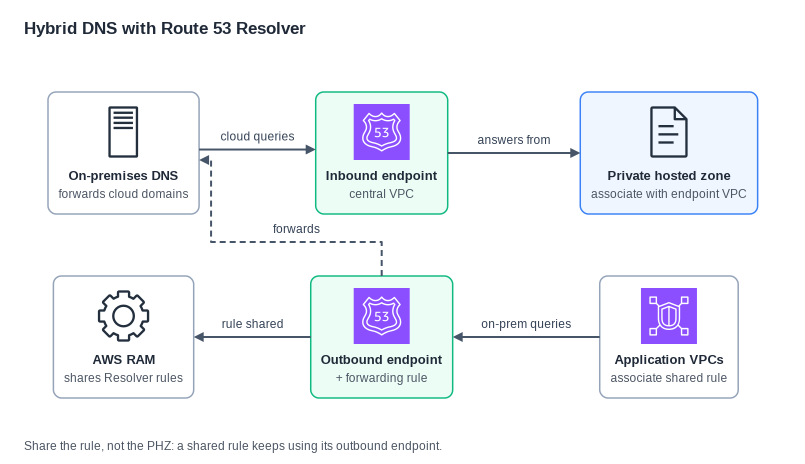
| On-premises resolves AWS private names | Resolver inbound endpoint (on-prem forwards to it) |
| VPCs resolve on-premises names | Resolver outbound endpoint + forwarding rule |
| Many accounts, one rule set | Share the rule with AWS RAM; accounts associate it with their VPCs |
| Inbound endpoint must answer from a PHZ | Associate the PHZ with the VPC that holds the inbound endpoint |
- "Each rule specifies the outbound endpoint that DNS queries are" forwarded through, so sharing a rule also shares the outbound endpoint: no new endpoint, VPN or VIF is needed in the other account.
- Split-view DNS: a private hosted zone with the same name as a public one returns NXDOMAIN for any name missing in the private zone, so every needed record must be copied (a Lambda/EventBridge sync handles future changes).
2. Transit gateway design
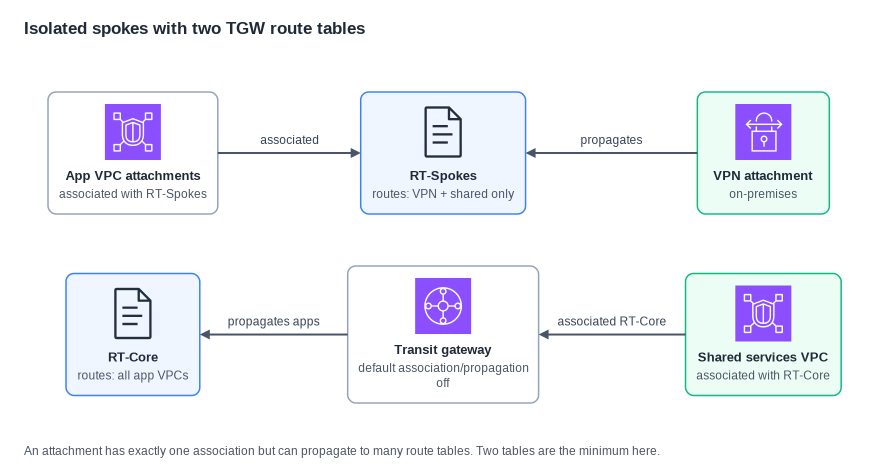
- Each attachment is associated with one route table and can propagate to many. With default association and propagation off, isolation of spokes = one spoke route table (receives only shared-services and VPN routes) + one core route table (receives all spoke routes). Two tables is the minimum.
- TGW is Regional. Cross-Region needs one TGW per Region and a peering attachment (static routes only) on both sides.
- Share a TGW with AWS RAM; the receiving account creates VPC attachments, the owner manages route tables. To merge two TGWs, share the existing one and migrate the attachments.
- VPN on a TGW can carry IPv6 (virtual private gateway cannot carry IPv6 inner packets). A VPN connection carries IPv4 or IPv6 inner traffic.
- Dynamic (BGP) VPN + propagation removes static-route maintenance when on-premises prefixes change.
- Accelerated VPN (Global Accelerator, nearest edge location) requires a transit gateway; virtual private gateways do not support it.
3. Direct Connect
| Topic | Fact |
|---|---|
| Maximum resiliency | Separate connections on separate devices in more than one location |
| Capacity under failure | Size so remaining circuits still carry the peak (4 Gbps ⇒ four 10G, not four 1G) |
| LAG | Same-speed connections aggregated by LACP at one location; cheaper than replacing with bigger links |
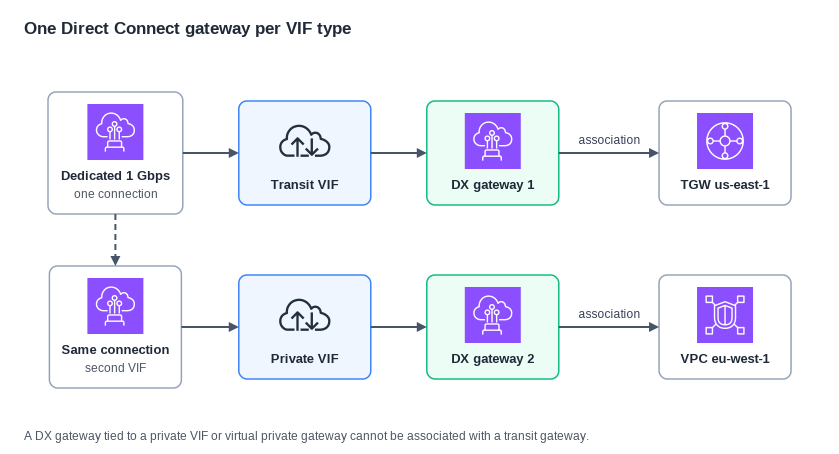
| Transit VIF vs private VIF | A DX gateway associated with a VGW or private VIF cannot be associated with a transit gateway ⇒ two DX gateways |
| Hosted vs dedicated | The exam expects a dedicated connection when one link needs both a transit VIF and a private VIF |
| SiteLink | Enable on existing private/transit VIFs; DC-to-DC over the AWS backbone, extra fee |
| Routing preference | Longest prefix first, then local preference (set with BGP communities), then AS_PATH |
| Allowed prefixes | For TGW associations only the allowed prefixes are advertised on-premises |
Active/passive: same prefix on both links, local-preference communities toward AWS and lower local pref on-premises. Active/failover with aggregates: advertise specific prefixes on the preferred path and an aggregate on the backup; longest match picks the specific route until it disappears.
4. VPC addressing and connectivity
- Secondary CIDR: if the VPC uses
172.16.0.0/12, you can add another block from that range (/16–/28), not from10.0.0.0/8or192.168.0.0/16. - VPC peering: no overlapping CIDRs; no bandwidth bottleneck, so it gives the highest throughput between VPCs. Overlapping CIDRs ⇒ PrivateLink (NLB-backed endpoint service + interface endpoint).
- Gateway endpoints (S3, DynamoDB) cost nothing; SQS needs an interface endpoint. Private subnet + endpoints avoids NAT gateway cost.
- Centralised interface endpoints: turn endpoint private DNS off, create a PHZ named like the service endpoint with an alias to the endpoint, associate it with every spoke VPC.
5. Load balancing and edge
| Requirement | Choice |
|---|---|
| Static IPs for devices without DNS, cheapest | NLB (one Elastic IP per subnet) |
| End-to-end TLS with your own certificate | NLB TCP:443 listener (passthrough) + cert on instances |
| Keep traffic in own AZ with failover | NLB with cross-zone off (default) + zonal DNS names |
| Global static anycast IPs, TCP, regional failover | Global Accelerator |
| Token check + header insertion before origin | Lambda@Edge (Include Body for POST payload) |
| Fast origin failover | Lower connection timeout/attempts (default 10 s × 3 = 30 s) |
| HPC | Cluster placement group (single AZ, up to 10 Gbps per flow) + EFA |
Exam traps
- Sharing a PHZ vs sharing a Resolver rule: share the rule.
- Same-name PHZ hides the public zone: copy every record.
- VGW: no IPv6 inner traffic, no accelerated VPN, no inter-Region.
- Private DNS on a centralised interface endpoint does not serve spoke VPCs.
- Hosted connection cannot give you both a transit and a private VIF.
- Aggregates plus specifics: longest prefix wins, so the aggregate is only a fallback.
- Auto Scaling launch templates cannot place a second ENI in another subnet; attach it from user data/lifecycle hook.
Docs
- https://docs.aws.amazon.com/Route53/latest/DeveloperGuide/resolver-choose-vpc.html
- https://docs.aws.amazon.com/Route53/latest/DeveloperGuide/resolver-rules-managing.html
- https://docs.aws.amazon.com/Route53/latest/DeveloperGuide/hosted-zone-private-considerations.html
- https://docs.aws.amazon.com/vpc/latest/tgw/how-transit-gateways-work.html
- https://docs.aws.amazon.com/vpc/latest/tgw/tgw-peering.html
- https://docs.aws.amazon.com/vpc/latest/tgw/working-with-transit-gateways.html
- https://docs.aws.amazon.com/vpn/latest/s2svpn/ipv4-ipv6.html
- https://docs.aws.amazon.com/vpn/latest/s2svpn/accelerated-vpn.html
- https://docs.aws.amazon.com/directconnect/latest/UserGuide/resiliency_toolkit.html
- https://docs.aws.amazon.com/directconnect/latest/UserGuide/routing-and-bgp.html
- https://docs.aws.amazon.com/directconnect/latest/UserGuide/direct-connect-transit-gateways.html
- https://docs.aws.amazon.com/vpc/latest/userguide/vpc-cidr-blocks.html
- https://docs.aws.amazon.com/elasticloadbalancing/latest/network/load-balancer-listeners.html
- https://docs.aws.amazon.com/AmazonCloudFront/latest/DeveloperGuide/high_availability_origin_failover.html