Exams / AI-103 / D1 Plan and manage an Azure AI solution
D1.1
Choose the appropriate Foundry services for generative AI and agents
- Choose an appropriate model for each task, including LLMs, small language models, multimodal models, and Foundry Tools
- Choose the appropriate Foundry services for generative tasks, grounding, vector search, agent workflows, or multimodal processing
- Choose an appropriate method for retrieval and indexing
- Choose appropriate memory, tool, and knowledge integration services for agent solutions
You are reading a free preview. The rest of the AI-103 course unlocks with an Exam pass or All access.See plans
Choosing a model type
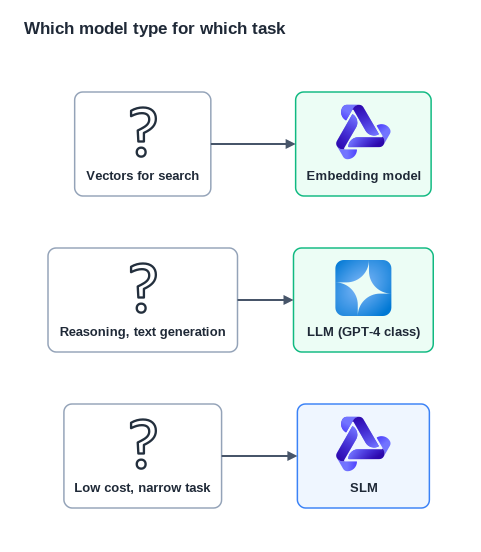
| Need | Model type |
|---|---|
| Deep multi-step reasoning, long context, detailed text | Large language model (LLM) |
| Cheaper/faster, narrower tasks | Small language model (SLM) |
| Numeric vectors for search or similarity | Embedding model |
| Text + images/audio input | Multimodal model |
| Generate names, summaries, code from text | GPT-4-class model |
Embeddings: "Each embedding is a vector of floating-point numbers, such that the distance between two embeddings in the vector space is correlated with semantic similarity between two inputs in the original format."
Comparing and deploying models
- Model leaderboards "help you compare models in the Foundry model catalog by using industry-standard model benchmarks" (quality, cost, throughput; model cards give details).
- The catalog offers managed compute and serverless deployments. With managed compute "Model weights are deployed to dedicated virtual machines"; serverless is billed per token ("You're billed for inputs and outputs to the APIs, typically in tokens"), so no weights are hosted in your subscription.
Retrieval and grounding
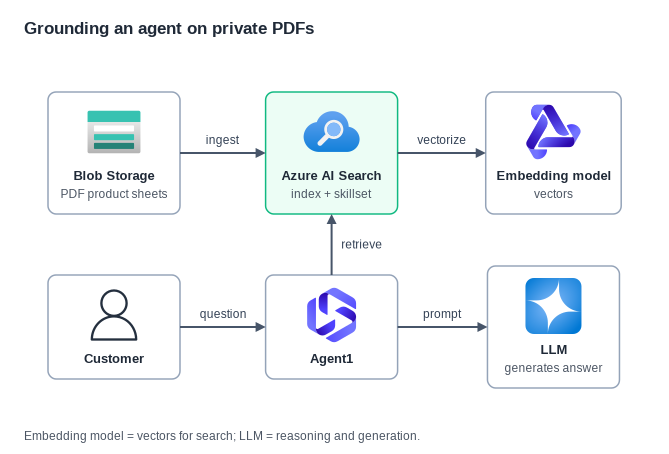
Azure AI Search is the retrieval service for RAG over private content. Integrated vectorization handles chunking and embedding during indexing and "minimizes maintenance tasks during data ingestion and query time".
Question answering over static documents
Custom question answering (Azure Language) builds knowledge bases from "FAQs, manuals, and documents". LLM chat output is nondeterministic; a seed only gives best-effort reproducibility. Note: CQA retires from Azure Language on March 31, 2029.
Exam traps
- Embedding model is not an LLM: vectors vs. generated text.
- Document Intelligence extracts content; it does not index or retrieve. Bing grounding is public web, not your Blob data.
- Serverless = no model weights in your subscription; managed compute = weights on your VMs.
- "Same answer every time" points to custom question answering, not a generative model.
Docs
- https://learn.microsoft.com/en-us/azure/search/retrieval-augmented-generation-overview
- https://learn.microsoft.com/en-us/azure/search/vector-search-integrated-vectorization
- https://learn.microsoft.com/en-us/azure/ai-services/openai/concepts/understand-embeddings
- https://learn.microsoft.com/en-us/azure/foundry/concepts/model-benchmarks
- https://learn.microsoft.com/en-us/azure/foundry/concepts/foundry-models-overview
- https://learn.microsoft.com/en-us/azure/ai-services/language-service/question-answering/overview
- https://learn.microsoft.com/en-us/azure/foundry-classic/openai/how-to/reproducible-output